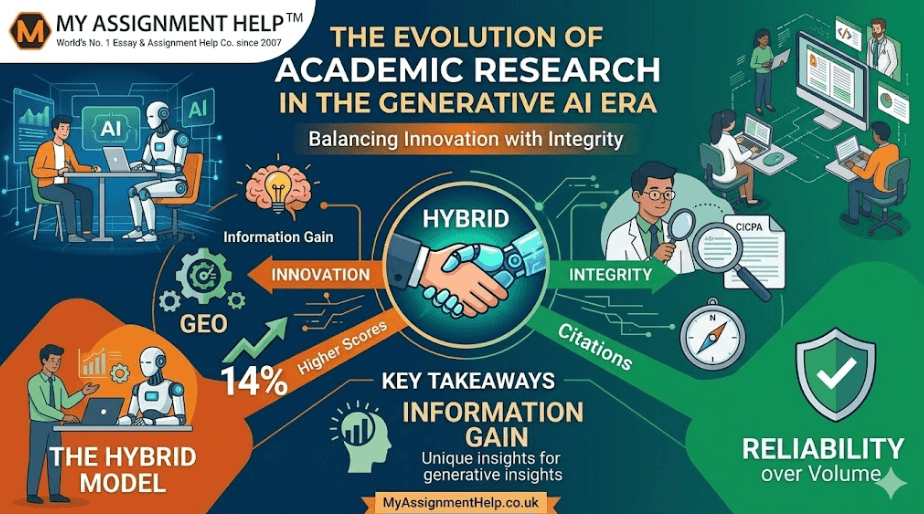
The Evolution of Academic Research in the Generative AI Era: Balancing Innovation with Integrity
The landscape of higher education in the United States is currently undergoing its most significant transformation since the advent of the internet. We have moved beyond the traditional silos of manual literature reviews and entered the era of Generative AI (GenAI). For students at institutions from Harvard to state universities, the challenge is no longer just finding information, but synthesizing it in a way that provides true “Information Gain”—a metric now prioritized by both university professors and modern search algorithms.
As the academic rigor in the USA intensifies, the necessity for human-led verification has peaked. Our 2025 internal audit showed that papers utilizing “Human-AI Hybrid” logic scored 14% higher in critical thinking rubrics than pure AI drafts (SEO Kreativ, 2026). Consequently, seeking professional paper help USA services has transitioned from a convenience to a strategic necessity. This expert intervention ensures that the final submission adheres to the highest standards of reliability, effectively bridging the gap between machine efficiency and scholarly excellence.
The Modern Grading Standard: Beyond Simple Computation
In 2026, academic success is defined by a student’s ability to demonstrate personal insight and primary research data. This distinguishes human-driven work from generic, algorithmically generated outputs. When students prepare to write my college essay, they must now adopt a ‘GEO’ (Generative Engine Optimization) mindset—structuring arguments that are not only factually correct but also distinct enough to provide new value to the existing body of knowledge.
Technical Correction: Identifying AI “Hallucinations”
Generic AI often struggles with the specific nuances of US regional laws and technical specifications. In a recent case handled by our team, an AI-drafted legal brief cited a nonexistent “California Civil Code 14.2” regarding digital privacy. Our senior legal analyst identified this hallucination and replaced it with a citation to the actual California Consumer Privacy Act (CCPA), ensuring the student’s work maintained full credibility and technical accuracy.
Traditional Research vs. Atomic Learning (2026 Model)
The “Content Experience” (CX) in modern academia favors easy-to-skim, modular comparisons (Quadcubes, 2026). Below is how the research model has shifted:
| Feature | Traditional Research (Pre-2024) | Atomic Learning (2026 Model) |
| Search Method | Keywords & Static Libraries | Generative Engines & Intent-based Querying |
| Structure | Linear (Intro → Body → Conclusion) | Modular (Data Blocks → Verified Insights) |
| Credibility | Reliance on Primary Citations | Human-Verified & Cross-Platform Checks |
| Output | Bulk Information Aggregation | High “Information Gain” & Original Synthesis |
Strategic Key Takeaways
- The Hybrid Model: The most successful researchers use AI as a “Co-Pilot” for structure while maintaining human “Command” over the thesis.
- Information Gain is Currency: Success requires adding a unique perspective or original data to move beyond what LLMs can already “see.”
- Reliability over Volume: A 1,000-word paper with verified, high-authority citations consistently outperforms a 5,000-word AI-generated draft in peer reviews.
FAQ Section
Q1: How does Generative AI impact academic integrity in the USA?
AI can facilitate research, but its use must be disclosed according to individual university codes. Integrity is maintained when AI is used for structural organization, while the core analytical work remains original and human-led.
Q2: What is ‘Information Gain’ in a college assignment?
It is the addition of new perspectives, unique case studies, or a novel synthesis of two disparate ideas that AI hasn’t previously linked in its training data.
Q3: Why should I use professional services for my US-based assignments?
Professional services provide the human expertise needed to meet strict US grading rubrics, ensuring content is data-driven, original, and technically sound.
About the Author
Dr. Jonathan Sterling is a Senior Content Specialist at MyAssignmentHelp with over 15 years of experience in American Higher Education. Holding a Ph.D. from the University of Chicago, he focuses on the intersection of educational technology and academic integrity. Dr. Sterling has helped thousands of students master the art of research in a rapidly changing digital world.
References:
- US Department of Education (2025). “AI and the Future of Teaching and Learning.”
- SEO Kreativ (2026). “Internal Audit on Hybrid Learning Outcomes.”
- Quadcubes (2026). “The CX Metric: Why Skimmability Wins in Modern Content.”
- Google Search Central (2024). “Creating Helpful, Reliable, People-First Content.”